
The sky this morning was clear and promised well. We therefore set out on a long drive to visit two of the local stone circles.
I have been interested in stone circles for decades - even before I visited Scara Brae in 1972 or Stonehenge in 1968.

Our first stop was Castlerigg, just outside Keswick. Dated around 3200BC, Castlerigg, or Keswick Carles, is one of the oldest stone circles in Europe,

The approach to Castlerigg is very simple. You drive along a tarmac road through a flat plane with fells on all sides and the stones emerge - right beside the road.

It is quite extraordinary to walk to the circle and stand in the centre of a really enormous bowl, completely surrounded by hills. It is impossible to capture the effect from the ground. I tried taking a panorama shot of the whole circle, but the resulting linear photograph does not show the effect.

I tried to take photos around the whole circle so the different hill formations can be seen.
It was the best possible day for seeing it - clear and crisp (also cold and windy!).
The circle is about 30 metres in diameter. Originally it probably once had 41 stones. There are at least 38 today, though some claim 40.
It has a small rectangle os stones inside the circle.


I was glad of my new down jacket and the head tube I bought yesterday.
This was a most memorable and moving visit. For whatever reasons our Stone Age ancestors build this circle (and that is still unresolved) it is easy to see why they chose this location.
Penrith
Heading into Penrith we passed the ruins of Penrith Castle. The ruins date from at least 1483 when an earlier keep became a fortress for Richard, Duke of Gloucester, before he became Richard III.

Penrith is decked in orange as it prepares for World's Original Dalemain Marmalade Awards & Festival next weekend.

We made our way through the town square to St Andrew's Anglican Church, whose red sandstone rubble tower was built in the 12th Century. The church was remodelled in the 18th Century.
The church has a couple of very beautiful stone crosses.The first is a 10th Century Anglo-Saxon cross on a modern sandstone bas. It was erected here in 1887.


The other is a modern cross, in memory of those who died in World War I.

There is also a structure known as the Giant's grave, consisting of two stone shafts and four carved hogbacks. They have been in the church since the 17th Century.


Inside, the church is very beautiful.It is consistently and simply panelled with galleries on three sides, reminiscent of dissenter churches.
There are painted panels on either side of the East window, by Jacob Thompson 1845.

The memorial to those from Penrith killed in WWI contains a shocking number of names.
There are two beautiful windows, made up of fragments,saved from a fire that destroyed the originals. The more intact is the Neville Window, reconstructed to commemorate Richard Duke of York and Cecily Neville but now believed to depict Joan Beaufort and Ralph Neville.
The less complete one may depict Richard II.


This is a rather lovely modern window.

The George Hotel in Penrith.is one of the many in which Bonnie Prince Charlie spent a night.

We had a delicious and pleasant lunch at the Board and Elbow Hotel.


Before heading out of town to Long Meg
Long Meg and her daughters

To the South of Penrith, near the village of Little Selkeld, lies the Bronze Age stone circle known as Long Meg and her daughters. When we arrived there was no-one else there so we had this enormous circle to ourselves.
It is so enormous that a farm road goes through the middle without interrupting the harmony.
There are 57 stones in this circle, from a probable original 70. 27 are still standing. The diameter varies from 93 to 100 metres. It is thought to be around 1500-1000BC.


Long Meg herself stands outside the circle and is made of local red sandstone, whereas the 'daughters' are granite. There are cup and ring marks on Long Meg.

There are, of course, many stories about these stones, some involving witches, or lovers. Another one is that the stones can't be counted.
I am really grateful to Sue for planning today and Alf for doing all the driving - which was extensive. We are all a bit tired from the effort.

This is how the sun went down on a remarkable day of learning and observing quite wonderful things.
 The forecast today was sunny - the only day on the horizon with this forecast - and the morning view from our window proved promising.
 We therefore followed our plan and headed down to the water to catch the 11.30 boat around Derwent Water. The boat wharf is directly opposite the Theatre on the Lake. The boat ticket office sells duck food, so there is always a collection of geese, ducks and swans waiting hopefully.


 Once again, the view to the South-West was dark


 but colour emerged to the North West.
 Along the water's edge there are paths with walkers and their dogs.


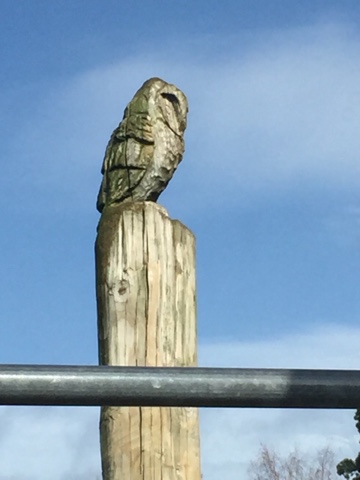 The owl on the jetty welcomed us back and we walked through Hope Park to the High Street, stopping for coffee on the way.


